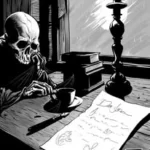
The Rats Under Pine Street Part 3
Monday morning, before I left for work, there were more than fourteen.
I stood in the kitchen doorway and tried to count them twice, but they moved around so much I lost track. They moved through the apartment with a familiarity that was either comforting or alarming depending on how long I was willing to think about it. Daisy found me at the kitchen threshold and stood up against my ankle, and I bent down and let her sniff my hand, and that helped.
I had read somewhere, or perhaps heard it, that music soothed animals. It seemed reasonable. I went to the cassette deck and put in Air Supply’s Lost in Love and pressed play figuring the soft rock would do the trick. The auto-reverse would keep it going all day. I turned the volume down to something ambient and unobtrusive.
“There,” I told Daisy. “That’s better than silence.”
She appeared to agree.
I went to work.
I heard Principessa before I reached the bottom of the stairs when I came home.
The dog was stationed outside my door, a small white shape in the dim hallway, vibrating with the steady outrage that seemed to be her default relationship with the world. She was not barking at the door so much as delivering a sustained professional opinion about whatever was on the other side of it.
I set down my bag and looked at her. She looked at me but did not stop barking.
 There were soon footsteps on the stairs above, then Mrs. Moretti’s voice preceding her around the landing.
“Principessa. Principessa!” She came into view, one hand on the railing, the other already reaching. “There you are. Princess Principessa, I thought you got out again. There are too many bad things out in this world that can get you.” She scooped the dog up and pressed her face into the white fur. Principessa transferred her grievance to Mrs. Moretti’s shoulder, growling steadily at my door.
“She was just here when I came in.”
“Thankfully Mister Martin found you here you little rascal,” Mrs. Moretti said to the dog, which I felt was not quite accurate but did not seem worth addressing. She looked up at me with the expression she reserved for moments of grudging approval. “Martin is one of the good ones, even if he his a little soft.” Then, without pause: “Don’t forget your rent is due next week.”
“I won’t.”
I watched her carry Principessa back up the stairs, the dog’s growling fading as they rounded the landing. I stood outside my door for a moment. Then I unlocked it and went inside.
 The cassette deck was gutted.
The wood casing had been chewed to splinters, the speaker cloth torn away in strips. The wires ran out of the back of it in a tangle, the insulation stripped from several of them in long clean pulls. Ribbons of tape from the cassette itself were strewn across the floor in loops and tangles, brown and glinting in the overhead light. The Air Supply tape, I noted, had been pulled from the machine at some point and thoroughly unmade.
I did not move for a moment.
There was a sound from behind the deck, a small sharp spit of electricity, and I saw the spark then, a live wire resting against a nest of tape ribbon and flannel strips and what appeared to be the remains of a dish towel. The spark came again. The debris was close enough that I could see where the ribbon had begun to discolor from the heat.
I crossed the room and pulled the power strip from the wall. The sparking stopped. I crouched down and carefully moved the nest of debris away from the wire with the edge of a magazine, my hands not entirely steady, and sat back on my heels looking at what was left of the cassette deck.
It had been a good one. Auto-reverse, Dolby noise reduction, a clean transport mechanism. I had saved for it.
Around me the apartment moved, the quiet industry of many small bodies in the walls, under the furniture, along the baseboard. Someone was chewing something in the kitchen. Someone else was in the bedroom, from the sound of it.
I sat on the floor and looked at the ruined deck and did not quite know what to do with what I was feeling.
Then something warm pressed against my leg.
Daisy had found me in the way she always did, without ceremony, simply appearing where I was. She stood up against my knee and looked at me with her bright unhurried eyes. I picked her up and she settled into my cupped hands with the easy trust she had always shown, her small weight warm against my palms.
I sat on the floor with my back against the couch and held her.
Around us the apartment continued its business. Claws on the floorboards. The tick of something small investigating the kitchen cabinets. The sound of rats, dozens, perhaps more, going about the work of being alive in a space that was becoming less mine with each passing day. I was aware of all of it. I sat with Daisy in my hands and breathed slowly and stroked her back with one finger and tried to find the steadiness that her calmness seemed to suggest was available somewhere.
She did not pull away. She sat in my hands and let me hold her and I thought, well, there it is. They just needed more of what I had been giving Daisy. More patience. More consistency. A person willing to meet them where they were. They were just rats doing rat things, as rats will, and no one had ever given them any reason to do otherwise.
And then Daisy began grooming my fingers, the way she always did, unhurried and certain, and I felt the whole argument settle into place. How could I look at that and conclude anything other than that I was doing the right thing. That love, applied with enough structure, was simply what was needed here.
After a while, that was enough.
The smell developed before I fully acknowledged it.
It came on gradually, the way most things did in those days, each one a little harder than the day before in a manner that made it easy to keep adjusting the threshold of what was acceptable. Monday night it was noticeable. By Tuesday it was the first thing I registered when I woke up. I had started to keep the window cracked despite the cold, which helped less than I had hoped.
I cleaned constantly. It became the primary activity of my evenings, scrubbing the baseboards, emptying the corners, going through the apartment on my hands and knees with paper towels and a bottle of all purpose spray that I was running through at a rate I had not budgeted for. The rats watched me from various elevations with the detached interest of spectators at an event that did not concern them. Oscar watched from the top of the refrigerator. I had stopped questioning how he got up there.
The mac and cheese was gone by Tuesday night. The rice was gone on Wednesday, the bag pulled from the cabinet and opened with a thoroughness that suggested planning. I found the scattered grains across three rooms. I had four dollars and some change until Thursday and a strong disinclination to spend any of it on anything other than food, which was its own kind of information about where things stood.
I found Daisy near the bedroom door that evening and carried her to the armchair. I had not sat in it for a few days and had forgotten about the cushion. Most of the stuffing was gone, redistributed into nests I had been finding in the corners of every room. I settled as best I could on the frame of the chair and its shredded fabric.
I had the remnants of a sleeve of crackers in my jacket pocket. I had been keeping food there out of some vague instinct toward necessity. I took one out and held it low between my knees where the others could not easily see, and Daisy took it from my fingers with her usual delicacy. My stomach made its opinion known. I gave her another one and told myself I was not hungry.
“I’m sorry I haven’t had much time for you,” I told her. She was focused on the cracker. “It’s been a busy few days.” I was so tired.
She finished it and looked up at me. I gave her a third and watched her hold it in her front paws, eating it with great concentration. For a few minutes the smell and the scratching and the hollow feeling in my stomach receded to a manageable distance.
I gave her the last one from the sleeve. She deserved it more than I did.
I went to bed Wednesday night with a glass of water and the reasonable intention of eating something on payday.
At three in the morning, something at my feet woke me. A sharp pinching at my toes, the kind of sensation that pulls you up through sleep before you have named it. I lay still for a moment in the dark, registering it, and then reached over and turned on the lamp.
 There were small movements under the comforter at the foot of the bed. I pulled it back. Oscar was there on my bed, between my feet with two others, none of whom scattered. He stared up at me, his black eye flat and cold, his red eye piercing and hot. I felt, very briefly and against all reason, that I was the one being judged. Not studied the way a nervous animal studies an unfamiliar thing. Evaluating me the way you mull over the answer to a problem you have already solved.
The others looked up at me with the mild curiosity of creatures who had decided I was part of the landscape. My feet had several small bite marks on them. Not deep. Exploratory, perhaps, was the word I reached for.
I started to pull my feet up and away from Oscar and I could swear he squinted those eyes just a little before he lunged and bit deep into my big toe. Reflexes jerked my foot away as Oscar and the other two scattered to the shadows of our apartment.
I sat up and considered this for a moment. My toe was bleeding through my fingers. I was very tired. Not from being woken, but from the exhaustion of trying very hard for a very long time and could feel the trying not quite reaching. I sat there with bite marks on my feet in the dark and I thought, just briefly, that it was all too much. That something had gone wrong that I could not fix with more patience or more crackers or more goodwill.
Then I thought about how hungry they all must be.
“I understand,” I said, to the room in general. “I haven’t been keeping up with the feeding.”
I washed the marks with soap and warm water in the bathroom and put band-aids on the bite that had broken the skin. I found a pair of thick socks and put those on too. Then I went back to bed and lay in the dark and listened to the apartment move around me, and waited for morning.
It was payday. Things were always better on paydays.