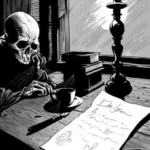
We Were Innsmouth One: The Leaving (1928-1929)

Click For All Chapters
One: The Leaving (1928-1929)
I have been putting off writing this first entry for some weeks now, which tells you something about my relationship with beginnings. I am considerably better with middles. I have been living in one for the better part of a century and I have made my peace with it. Beginnings require you to go back to the thing that started everything, and the thing that started everything was not a pleasant thing, and local squid ink, while plentiful, is not cheap in the emotional sense.
But the current has been wrong since autumn and I am not sleeping well and my ninety-seventh anniversary of arriving in this city is approaching in March, which seems as good a reason as any to finally pick up the pen and start at the start.
So. Innsmouth.
I should tell you about Innsmouth, for those of you who were born here in Providence or came to us from other waters entirely. You should know what was lost. Not as a wound to pick at indefinitely, I am far too old for that particular hobby and the picking has never once improved the wound, but because you cannot understand what we are gathering towards if you do not understand what we were driven from. The shape of a loss determines the shape of what replaces it, if you are lucky enough for anything to replace it at all.
Innsmouth was not a pretty town. I want to establish that before nostalgia does what nostalgia always does to the truth, which is to say smooths it down and removes the splinters until what you are holding no longer resembles the original object. It smelled. The fishing had been declining for years before Captain Obed Marsh came back from the South Pacific with Lord Dagon’s covenant and everything that followed from it. The smell of declining fishing is a specific and persuasive smell that works its way into the timber of buildings and the weave of clothes and eventually into the character of the people who live among it. The humans who remained in Innsmouth in that time were suspicious and largely humourless and deeply tired in the way of people who have been keeping a secret so long they have forgotten what it would feel like not to.
This was before the change, you understand. It was simply their nature.
But it was ours. The streets were ours. The water was ours. Devil Reef sat in the grey Atlantic offshore, and beneath it Y’ha-nthlei, old and cold and patient, full of the gold that Lord Dagon sends up to his faithful the way a father slips coins under a pillow while the children sleep. We knew what we were in Innsmouth. We did not have to explain ourselves or walk carefully or keep our collars turned up against the scrutiny of strangers. We did not have to be anything other than what we were, which is a freedom so complete that you do not understand its value until the morning it is taken from you between two and four a.m. by men with government paperwork and very large guns.
You do not understand what that is worth until it is gone. I have had ninety-seven years to understand it. I am still working on it.
There had been signs, in the months before February of 1928, that something was coming.
I want to be honest about this because I have spent ninety-seven years being selectively honest about it and I think the full document deserves the fuller truth. We knew. Not all of us, not with the specific knowledge of dates and trucks and government warrants, but in the way that a people who have been watched for long enough develop a sensitivity to the quality of the watching. The watching had changed in the years leading up to the raids. It had acquired a purposefulness, a patience, the particular quality of attention that is not curiosity but preparation.
There were those among us who said so. There were elders who had felt it in the current and brought their feeling to the community with the careful language of people who do not want to cause panic but have run out of ways to avoid it. There were meetings, in the old way, below the surface where the words could not carry to unfriendly ears, and the meetings produced what meetings of frightened people in the face of an advancing government usually produce, which is disagreement and delay and the deeply human, or in our case deeply natural, instinct to believe that the thing you are afraid of will not actually arrive if you do not look directly at it.
Some left before the raids. The ones with the most foresight or the least to lose or simply the particular disposition of people who have always trusted their own instincts over the consensus of the room. They went south and west and out to sea, and some of them made it to safety and some of them did not and some of them ended up in Providence four years before I did, building the quiet life on Wickenden Street that would receive me when I finally arrived.
The rest of us stayed. I stayed. I have thought about why I stayed, in the ninety-seven years since, and I have arrived at an answer that does not entirely satisfy me but has the virtue of being true, which is that Innsmouth was my home and I was not yet ready to believe that a home could simply be taken from you by people with the right paperwork.
I know better now.
The raids came in February of 1928.
I have started that sentence many times over many years and it never gets easier to finish, which I mention only because I think it is important to be honest about the fact that time does not actually heal this particular wound. Time buries it, which is not the same thing, as I have learned from watching them bury rivers. The thing is still there underneath. It still moves. It still knows what it is.
The government had been building its case for some time, accumulating the complaints of people who had looked at Innsmouth from a comfortable distance and decided that whatever was happening there was incompatible with their understanding of the proper order of things. This is how it always begins, with the people who look from a distance and decide that what they are seeing is a problem requiring administration. They never ask if the thing they are seeing minds being administered. That question does not appear to occur to them.
The trucks came at night, which I will say for them was at least honest. The things that governments do in the dark should be done in the dark. It is when they start doing them in daylight with flags and speeches that you know something has gone genuinely wrong with the machinery.
I was in the water when they came, which is the only reason I am here to write this. I felt the disturbance before I heard it, the particular vibration of heavy vehicles on the Innsmouth roads carrying more weight than fishing trucks carry, moving with more purpose than fishing trucks move. I surfaced in the shadow of the Fish Street wharf and I watched the lights moving through the town and I heard, carried across the water with the particular clarity that cold February air provides, sounds that I will not describe in this document because some of the people reading it may have been there and do not need me to describe them and some were not there and do not need me to either.
I will say only this: they were efficient. Whatever else you say about what the government did in Innsmouth that February, and I have said many things about it over ninety-seven years, most of them not suitable for a written document that others may read, they were efficient. They had decided on an outcome and they achieved it with the minimum of deviation and the maximum of thoroughness and by the time the sun came up over the Atlantic the town of Innsmouth was in the process of being permanently erased from the map of Massachusetts and the lives of the people in it.
I watched from the water until watching became dangerous and then I went under and stayed there for a long time in the cold and the dark with Dagon’s presence around me like the only solid thing left in the world.
Then the depth charges began.
I will not describe what a depth charge feels like in the water because I do not have the words for it and because the words I do have are not ones I choose to use in a document that others will read. What I will say is that the water, which had been my refuge and my protection and the place where Dagon’s presence held me together through the worst hours of that night, became in an instant something that was trying to kill me. The concussion moved through it like a fist. Then another. Then another, each one closer to the reef than the last, the Navy working their way outward from Y’ha-nthlei with the same methodical thoroughness they had applied to the town above.
I was driven shoreward whether I intended it or not. The water does not argue with depth charges and neither, it turns out, do I. I found the shallows by instinct rather than direction, wedging myself beneath a shelf of rock and growth perhaps a quarter mile from the town’s edge, and I stayed there while the charges continued and the reef groaned with something that was not sound exactly but that I felt in my chest and my skull and in whatever I have instead of a soul.
Eventually it stopped. You always wait for it to stop. This is either the best or the worst thing about being what we are and I have gone back and forth on it for nearly a century.
I surfaced at dawn.
Innsmouth was still burning. Not the good kind of fire on water, not Mother Hydra’s sacred flame, not the defiant burning of a Gaspee in the bay. Just destruction. Just the particular orange and black of buildings that have been set alight by people who wanted to make certain nothing remained, reflected on the water of the harbour in a mockery of everything fire on water is supposed to mean.
I watched it burn from the shallows until the tide came in around me and then I turned south and I did not look back.
I have not looked back.
This document is the first time I have made myself look back.
It is enough.
I left on foot, heading south and west along the coast, which tells you something about the state of my transformation at the time. I was perhaps sixty percent of the way to what I am now, still able to pass as human with effort and the right conditions, still capable of moving through the surface world if I did not linger anywhere long enough for anyone to look at me directly in good light. I had a coat, a large one, and a hat with a brim that I could pull down, and I had learned over the preceding decades the particular art of moving through human spaces with the confident unremarkability of someone who belongs there and is simply on their way somewhere else.
The coat I had taken from a house I will not identify. The family was gone by then. I prefer to think they would not have minded.
I walked to Rowley in the dark, keeping to the marsh edges where the ground was soft and the shadows were cooperative. The marshes in that part of Massachusetts have a quality at night in February that I have not found duplicated anywhere else on this coastline, a particular combination of cold and silence and the smell of salt water and frozen reed that is not comfortable exactly but is deeply, specifically itself, the kind of place that knows what it is and makes no apologies for it. I found this, in the numb hours of that first night, unexpectedly sustaining.
From Rowley I found the road to Newburyport and followed it at a distance, parallel through the fields, until the town came up around me and I was able to join the foot traffic on the main street with reasonable anonymity. In Newburyport I found a farmer loading his wagon outside a feed store before dawn, a large quiet man who looked at me once, noted the coat and the hat and the general demeanour of someone who had been through something he was not going to discuss, and said nothing at all for the entirety of the ride to the edge of his property, which was the finest quality he could possibly have demonstrated under the circumstances.
From there I made my way south by degrees, sometimes by road, more often by water, moving at night when I could and resting in the deeper channels when I could not move safely. It was February, which is not the month I would have chosen for a coastal migration, but February did not consult me on its scheduling.
I passed through Gloucester without stopping, which required a particular effort of will. Gloucester smelled like fish and deep water and the particular salt-grief of a fishing town that has been sending its men into the Atlantic for three hundred years and getting back approximately what the Atlantic felt like returning. I understood that smell. I could have stayed. But Gloucester was too close to Innsmouth, too likely to be watched, too small to hide in for someone who was beginning to look the way I was beginning to look.
There was one night, anchored in the deeper water off the Gloucester harbour, when I felt something in the current that stopped me entirely. Not a threat. Not the vibration of government trucks or the purposeful attention of watching that I had learned to read in the months before the raids. Something older than that. A recognition, moving through the water from the direction of the open Atlantic, brief and faint and entirely unmistakable.
Dagon knew where I was.
I do not know how to say that with more precision than that. I am not a theologian and I have never been comfortable with the language of divine intervention, which tends toward the grandiose in ways that do not suit either my temperament or my prose style. What I felt was what I felt and what I felt was that the deep water knew me and that the deep water was, in some way I could not then and cannot now fully articulate, not indifferent to what had happened and what I was doing about it.
I stayed in that harbour longer than was strictly safe and I let the current tell me what it had to tell me and then I went south again, lighter than I had been, which considering what I was carrying was not nothing.
I passed through Salem without stopping, for entirely different reasons that I trust require no elaboration.
I passed through Boston in the dark, moving through the harbour channels, and felt the city above me as a kind of pressure, all that human mass and urgency concentrated in one place, pushing down on the water with the weight of its own importance. Boston has always had an extremely high opinion of itself. I have found this, over the years, to be Boston’s most consistent characteristic.
Then the coast curved west and south and the water changed, and somewhere in that change I felt something that I had not expected to feel in February of 1928 with Innsmouth still raw in whatever passes for my memory.
I felt welcome.
Not from a person. Not from any specific presence I could identify or name. From the water itself, from the particular quality of the current as it moved through the bay, from something that had been in these waters long before I arrived and recognised in me, or in what I was, something it had been waiting for. The ones who had come before me, the six families on Wickenden Street who had read the signs earlier and chosen the wiser path, had not come empty handed. You do not leave your home, however dangerous the staying has become, without carrying something of it with you. They had carried Dagon with them down the coast, not in any object or vessel but in the older way, in their faith and their practice and the daily devotion of a people who knew that a god lives where his people tend him. They had tended him in the Providence River for four years before I arrived, quietly and without ceremony, and Dagon had taken root in those dark waters the way he takes root wherever his faithful bring him, slowly and deeply and with the patient permanence of something that has decided to stay.
That is what I felt when the bay opened up around me. Not a strange water. A familiar one. Dagon’s presence, thin still and young as such things measure youth, but real, and growing, and glad, if such a word applies, of one more of his people coming home to tend it.
I came ashore at India Point as the sun was going down on a Tuesday in March, 1928. It was raining.
It is frequently raining in Providence in March. I have come to regard this as the city’s one great consistency and, on balance, a point in its favour.
Others were already here.
Six families, living quietly in the narrow houses of Fox Point, that tight neighbourhood of steep streets and close-packed buildings that pressed its back against the waterfront as though it had something to hide, which of course it did. The Portuguese fishermen who dominated the neighbourhood had been there for generations, the Silvas and the Costas and the DaCunhas and the rest, and among them, invisible in the way that only very careful people can be invisible, our people had established themselves with the patience of those who understand that belonging to a place is something you build slowly or not at all.
The Marshes had come first, or what remained of the Marshes after the raids, three of them, an older woman whose name I will not write here because she asked me not to and I have honoured that request for ninety-seven years and see no reason to stop now, and two younger ones who had made the journey south ahead of the government trucks with the foresight of people who had been watching the horizon for exactly this kind of weather. They had been in Providence for four years before I arrived, long enough to establish the fish market on Wickenden Street, long enough to know which neighbours asked questions and which ones operated on the admirable principle that other people’s business was other people’s business.
When I came ashore at India Point and made my way to the address I had been given by someone in Newburyport who had known someone in Gloucester who had known where the Providence contingent had settled, the older woman whose name I will not write opened the door before I knocked.
She looked at me for a long moment in the way of someone taking a thorough inventory. Then she stepped back and let me in.
“You are later than we expected,” she said.
“February is not a good month for travelling,” I said.
“No,” she agreed. “It is not.”
She fed me. I will not say what, because it would require explanation, but it was warm and it was from the deep water and it was the first thing I had eaten in two weeks that did not taste of grief and road mud. I ate it at a small table in a kitchen that smelled of brine and old wood and the particular domestic peace of people who have made the best of a situation they did not choose. She sat across from me and watched me eat with the expression of someone who has been expecting bad news for four years and is simply relieved that the person carrying it is alive enough to deliver it in person.
We did not speak of what had happened. Not that night. She knew and I knew and the knowing sat between us at the small table like a third person who had not been invited and was not going to leave. There would be time to speak of it. There would be, as it turned out, decades. But that first night in the Fox Point kitchen, with the rain on the windows and the river a short distance away and the smell of deep water cooking on the stove, was not the time.
I ate. Then I slept, for a very long time, in a narrow bed in a narrow room with the sound of the Providence River close enough to hear if the city went quiet, which in March of 1928 it sometimes did.
I did not dream of Innsmouth.
I dreamed of gold, coming up from the deep in the dark.
Lord Dagon provides for his faithful.
He provided that night. I was grateful. I remain grateful.
– S.Z., Providence, February 2025