We Were Innsmouth Prologue: Providence

Prologue: Providence
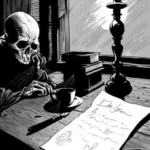
I am writing this by hand, in the old way, with ink I make myself from the longfin squid that run through the upper bay in good numbers if you know where to look and how to ask, which after nearly a century in these waters, I do. The purists would call it sepia only if it came from cuttlefish, which do not run in Narragansett Bay as the longfin and shortfin squid do. I have made my accommodation with the available materials, as I have made my accommodation with most things in this city, and the ink holds well enough and longfin squid are abundant.
The shortfin squid are better eaten than written with, in any case. The restaurants along the waterfront fry them with hot cherry peppers, a preparation this city has perfected over several decades, as Providence does most things: through politics and the occasional involvement from the renowned families of Federal Hill. The result is, and I will state this plainly, the peak of what the surface world has achieved in the culinary treatment of cephalopods. It only narrowly outperforms the clear broth chowder that Rhode Island makes correctly while the rest of the coastline continues to add cream or tomato to something that requires neither. I do not share these opinions publicly. I am trying to maintain a low profile. I share them here because this document is addressed to people who live in Providence and therefore already know I am right.
The pages I write will smell of the sea. Everything I touch smells of the sea. This has occasionally been a problem in social situations, though I have had fewer of those as the decades accumulate.
It is a Tuesday in April, 2026, and the city above me is doing what it always does, moving, consuming, generating the particular low frequency noise of human habitation that I have learned to sleep through the way you learn to sleep through anything that does not actually intend to kill you. The river is cool and the current is good and somewhere upstream the university students are finishing whatever it is university students finish in April, their brief urgent lives contracting toward summer with the focused energy of creatures who understand, on some cellular level, that they do not have much time.
They do not know how right they are. But that is not what I am writing about.
I have lived in Providence for ninety-eight years and I have never once been asked to leave, which either speaks well of the city or poorly of their powers of observation.
I am writing this because something is coming.
I will not say what. I am one hundred and sixty-three years old and I have learned that naming a thing too early gives it ideas. What I will say is that I have felt it in the current for some years now, a pressure change, deep and slow, the way the water feels before something very large moves through it. The young ones cannot feel it yet. The young ones are busy with their phones and their anxieties and their elaborate coffee preparations, and I do not begrudge them this. They have not had a century to learn the difference between the ordinary darkness and the deeper kind.
That is why I am writing this down.
But I am getting ahead of myself, which is a habit I have been developing for approximately a century and a half and see no reason to correct at this point.
Let me tell you about this city first. Not its history, or not only its history, but its nature, which is a different thing and in my experience considerably more important.
Providence is a city of water and fire.
I do not mean this as poetry, though it is that too. I mean it as a statement of fact about what this place is in its bones, what it has always been, what it was before we arrived and what it will be long after whatever is coming has come and gone. The water was here first, the rivers running dark and cold from the hills down to the bay, Narragansett Bay opening out to the Atlantic like a hand reaching toward something it cannot quite name. The Woonasquatucket. The Moshassuck. The Providence River where they meet and slow and consider the sea. This is Dagon’s newest home, deep and patient and old in the way that water is old, which is to say older than anything that has ever lived above it.
But the fire came early too, and it came in a way that I have spent ninety-eight years thinking about.
On the ninth of June, 1772, a British customs schooner called the Gaspee ran aground on a sandbar at Namquid Point in the bay, south of the city. She had been making herself disagreeable to Providence merchants for some time, the particular disagreeable quality of a government instrument that has confused authority with righteousness, which governments do with a regularity that I find both predictable and exhausting. That night a group of Providence men rowed out to her in longboats, boarded her, shot her commander in a place that I am told was painful but not fatal, and burned her to the waterline.
Fire on water.
Hydra’s flame on Dagon’s surface.
This was more than a year before the Boston Tea Party, which gets considerably more attention in the history books, presumably less because tea is more photogenic than a burning customs schooner, more because drunken Bostonians make more noise about things. But it was here, in this bay, that the revolution first expressed itself as something more than complaint. It expressed itself as fire on water, which is the oldest language there is, and Providence has been speaking it ever since.
I was not here for the Gaspee. I want to be precise about that. I am old but I am not quite that old, and I have no interest in claiming a history that is not mine. But I came here in 1928 with the smell of Innsmouth’s burning still in whatever passes for my memory, and I found a city that had begun its own story with a burning as opposed to and ending, and I felt something in that correspondence that I did not have words for then and am only now, ninety-eight years later, attempting to put into squid ink on paper.
We did not choose Providence arbitrarily. No people chooses its refuge arbitrarily, whatever story they tell themselves about practicalities and harbour depths and the quality of the fishing. We came because the water was deep and the rivers ran close to the heart of the city and others of our kind had already found their way here and declared it sufficient. These are true things.
But I have come to believe, in the long years since, that there was another reason. Something that called to us below the level of conscious decision, below even instinct, in that place where the oldest knowledge lives. This city had already proven, one hundred and fifty years before we arrived, that it understood something in its bones about the relationship between what burns above and what endures beneath.
Father Dagon. Mother Hydra. Deep water and defiant fire.
Providence has always worshipped at this altar. It simply did not know the name of what it was worshipping.
It still does not know. Every time they light the braziers on the river, every time the fire catches on Dagon’s surface and the city gathers to watch with that particular collective stillness of people in the presence of something that has touched something old in them, they do not know. They think it is art. They think it is civic celebration. Barnaby Evans, who conceived of WaterFire in 1994 and has my profound and entirely unasked for gratitude, thought he was making something beautiful.
He was. He also, without knowing it, restored a sacrament that this city had been performing in one form or another since before it had a name.
Mother Hydra’s fire on Father Dagon’s water.
But I am getting ahead of myself again. WaterFire is a matter for a later entry and we are not yet at that later entry. We are at the beginning, which is where all things must start, even things that are one hundred and sixty-three years old and would frankly prefer to start somewhere in the middle where it is warmer.
I should tell you who I am writing this for, because a document written for no one in particular tends to become a document that says nothing in particular, and I have too little ink and too much to say for that kind of indulgence.
I am writing this for us. For what remains of us, scattered along this coastline and beyond it, in the deep places and the shallow ones, in the cities that took us in without knowing it and the waters that held us without being asked. I am writing this for the old ones who remember Innsmouth and carry that memory like a stone in the chest, and for the young ones who have never seen it and carry its absence like a different kind of stone. I am writing this for the ones who came to us recently, the new blood, the ones who found their way to Dagon’s waters through love or loss or the particular stubborn persistence of blood that knows what it is even when the mind does not.
I am writing this because we are fewer than we were and something is coming and I am one hundred and sixty-three years old and I have run out of patience for waiting to see if things resolve themselves.
They do not, in my experience, resolve themselves. They resolve because someone makes them. Like the burning of ships and the spilling of teas.
My name is Stanislas Zotykiv. I came to Providence from Innsmouth, Massachusetts in March of 1928, in the rain, with nothing in my pockets worth mentioning and everything in my head worth writing down.
This is what I remember.
This is what you need to know.
This is where we begin.
– S.Z., Providence, April 2026